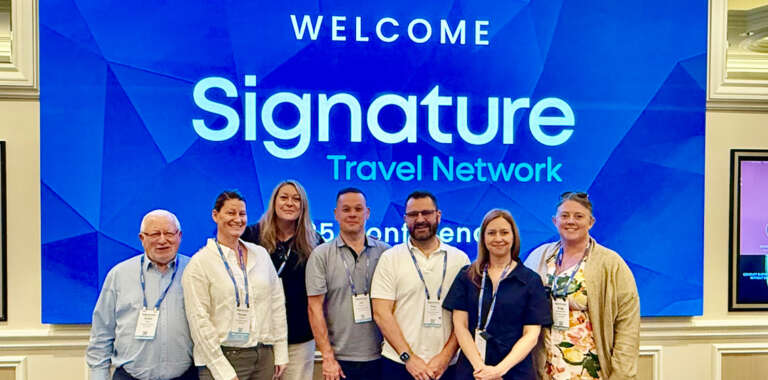



In a conversation ahead of Signature Travel Network’s Annual Conference in Las Vegas this year, held November 10-13 at The Venetian, Karl Kannstadter, VP content strategy – Exploration for the network, said that interest in exploration travel is booming – but there’s still plenty of room for growth.
To learn more about this budding, but still-growing, travel segment, LATTE spoke with a handful of advisors and supplier partners during the conference to get their take.
Notably, they all said that exploration travel is for everyone – regardless of age, regardless of fitness level, regardless of the need for air conditioning, Wi-Fi or any other modern comfort. So, if you have a dearth of “exploration travelers” in your client list, it’s possible some of them may have more interest than you’ve assumed.
Here are the top tips gleaned from Signature’s experts for selling more exploration travel:
Use the Right Verbiage
When some people here “exploration travel,” thoughts of strenuous excursions may come to mind. In reality, that doesn’t need to be the case.
Jessy LaPaglia, luxury travel advisor with Preferred Travel & Co., explained that exploration—to her and her clients—it more about experiencing a destination in-depth and up-close. “It doesn’t have to be active, but getting to places that you couldn’t otherwise if you were on a bigger ship or going with a certain operator.”

Steve Smotrys, managing director and SVP commercial for the Americas for HX, agreed. “The word ‘expedition’ sometimes scares some people away, and they get intimidated by it,” he said. “I think that they always think it’s [going to be] high adventure, so we always try to emphasize that it’s really accessible to anybody.”
For Wendy Zappelli, sales and marketing representative, U.S., for Explora Hotels, the distinction between “exploration” and “expedition” lies in how much moving there is for the client. “With expeditions, you move from point A to B to C, so you’re actually on the move or on the road—or I often would say off-road, in our case.”
Clients wanting exploration can visit Explora’s lodges “to connect with nature, to explore more deeply” the destinations in South America in which it operates. Explora’s expeditions, on the other hand, “would be for the person that has a bit of an adventurous spirit and wants to go to the remote.”
Inform Clients of Their Choices While Traveling
LaPaglia said that “explaining to clients that they have options” is crucial. If she has clients interested in Antarctica, she always lets them know they, for instance, could hike to the top of a mountain, enjoy a “short, little hike” near the landing side, or just “hang out with the penguins.” She added: “It doesn’t have to be that difficult if you don’t want it to be.”

To that point, most suppliers offer a variety of experiences for all sorts of fitness levels. For example, on an HX sailing in the Galapagos, guests may have the option of snorkeling offshore of a small island where the tides are a bit tougher, or closer to shore where swimming is easier. For those who want to avoid going in the water entirely, they can opt for a glass-bottom boat tour.
“We’re always trying to carry something for every activity level and make it as accessible as possible,” said Smotrys.
Qualify Your Clients
One reason clients may have an interest in exploration travel, said Cindy Chambers, a partner at Beyond Group Travel, is they feel they are mobile now and may not be some years down the road. With that in mind, they are trying to “get their bucket list managed.”
That said, “They might have this idea popping up in their head that they absolutely want to go to Greenland or Swedish Lapland, but we need to be really realistic,” about their fitness levels and willingness to forgo certain luxuries, said Debora Ólafsson, head of product at Nordic Luxury.
Added Paul Tomasch, president of ICS Travel Group Americas: “Most of them (ICS’ clients) are really not that interested in anything difficult, but because it’s such a trendy word right now—exploration and adventure—they all want to throw it in, and then we have to really clarify what they want, because most people don’t want what we would suggest.”

If you feel your client might not be fully honest—with you or themselves—as LaPaglia hinted at to LATTE, Kannstadter suggested hopping on a three-way call with your supplier partner. He noted that one Signature partner has an 80-plus percent close rate any time they join a call with an advisor and a client.
When you’re on that call, tell your client, “You need to be really, really honest.” Make space for them to share their “limitations, restrictions, mobility, et cetera,” with the supplier, so you can find the exact right for the client.
Said Tourism Western Australia Regional Manager, Americas Emily Lawrence: “Trust your brands. Trust your partners. There’s a reason we do this. There’s a reason we all show up here. Trust them. They’ll look after you.”
Look Outside the Box
Sometimes an exploration traveler doesn’t look like an exploration traveler.
Smotrys explained that HX digs into the psychographics of its travelers. Typical demographics—like the client’s age—are becoming “a little bit irrelevant” because “it is more about what people are interested in, what really drives them.” In HX’s marketing, he said, “we call our guests curious travelers. It’s not about necessarily the fitness of the experience, but it’s about the curiosity, it’s about the learning.”

Zappelli added that “our average age range has definitely dropped.” Where Explora was historically in the 55-and-up range, its lodges are seeing a lot of younger guests—including those in their 20s and 30s, many of which are “adventurous honeymooners.”
Multi-gen is even blooming in the exploration travel space. LaPaglia—who noted she’s based in Naples, FL, and has a lot of mature clients—said she’s seeing grandparents taking their adult children and/or grandchildren on more active trips. Grandma, perhaps, wants to stay on the ship and drink champagne or enjoy a spa treatment, but the boys want to be out hiking or kayaking.
“They would have never picked an expedition [cruise] if it weren’t for the kids.”
Consider Cross-over Interests
Along those lines, consider clients who have interests that overlap with exploration travel—such as wellness.
“People that are looking to detach from their normal world, have some sort of introspective moment, and going to these locations are all opportunities to do that,” said Smotrys.
Zappelli backed that up, even noting that Explora has considered positioning itself as a wellness destination. “I believe that being in these remote areas—whether it’s on an expedition cruise ship or out in the wilderness at one of our luxury lodges—that it’s the definition of wellness. You’re immersed in nature multiple days … And there is a huge wellness element there that I think everyone is craving in our very fast-paced, technologically driven world.”

Kannstadter agreed, noting that people are “hitting a wall” and are in need of a detox and to get away. Some suppliers, he said, “unapologetically state ‘no Wi-Fi,’” and that he expected there to be a movement toward this type of travel in the future.
“Life is stressful,” said Tomasch. He told LATTE that clients are asking “to leave everything behind” and visit destinations where “people live a more natural life.” For him and his clients, that’s Asia.
Show, Don’t Tell
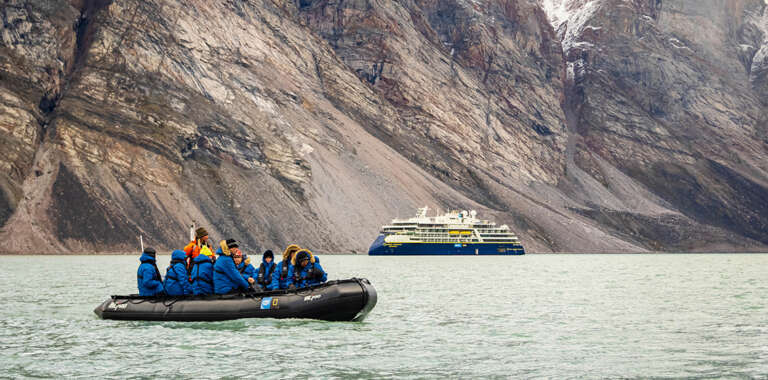
Clients who may be on the fence about “exploration travel” may be deterred—as mentioned already—by some of the verbiage required to explain what the experiences entail: zodiacs, dry landings, wet landings. Kannstadter says one way to bridge this gap is to show the clients someone—or better yet, the advisor—actually “doing the thing.” Clients will then realize, “I can do that!”
And for advisors, try to push yourself a bit while joining a FAM trip. Zappelli explained that she tells every visitor, “There will be a point on this trip where you will be asked to, maybe, step out of your comfort zone a little bit.” She always reminds them that they are “in a very safe environment with professional guides, where their top priority is safety.”
Zappelli added: “I hear stories all the time about people having transformational moments, or a moment where they thought they couldn’t do it, and then they realized they could do something hard.”
If an advisor can share this story with their clients, they will surely feel more confident in their ability to thoroughly enjoy the experience.
Break Up the Trip

“People want to feel adventurous, [but] at the end of the day, they want to have a nice accommodation,” said Tomasch. Often, he said, clients might book something adventurous during the day, but they still want a nice hotel room, and the “adventure experience ends in the hotel bar.”
Chambers told LATTE she will break up a trip to ensure her clients have the right mix of comforts and adventure. While noting her clients “have no problem getting up and out and not having Wi-Fi,” they will also want “champagne on the zodiac.”
Joking about her Texan roots and how “we love and crave air conditioning” said when she books safaris she will include a couple nights at Four Seasons Safari Lodge Serengeti “because it has fabulous air conditioning.” But bookending that stay may be a few nights at a tented camp.
Lawrence, along those lines, recommended the property El Questro Homestead, located in the middle of a Wilderness Park. “It’s a beautiful lodge, but it lets you have a taste of the Kimberley.” They offer their own river cruise on the Pentecost River and “it feels like you’re on a zodiac out in the Kimberley but [then] you’ve returned back to your luxury lodge and you have all your comforts.”