


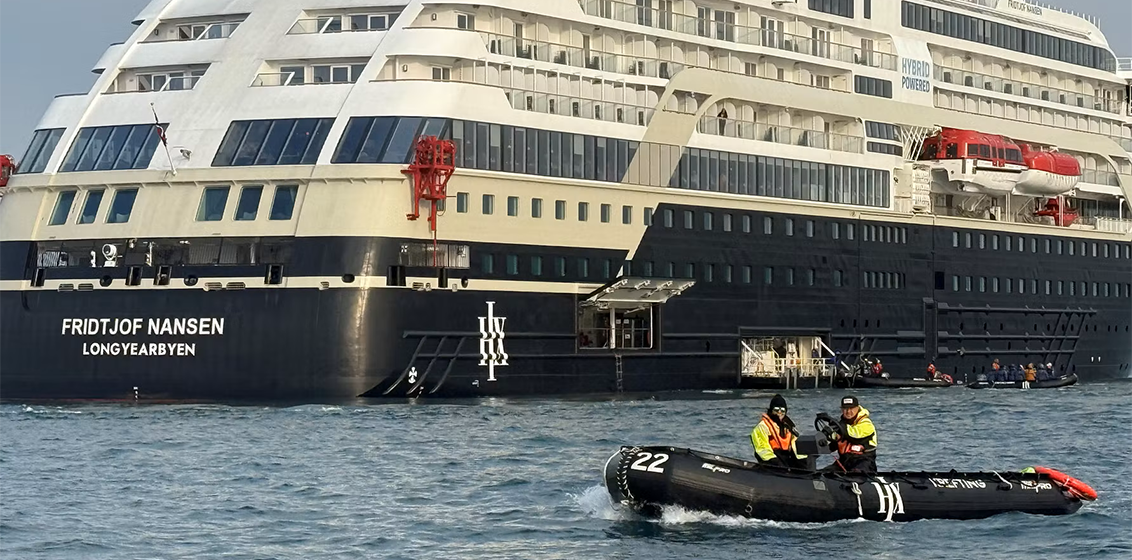
The launch of two fully electric “silent science boats” by HX Expeditions offers guest scientists and travellers the ability to study marine life “with minimal disturbance.”
The new MK 5 vessels are equipped with RAD Propulsion’s RAD 40 drive system which the company described as “the most advanced electric drives on the market”. They will be deployed aboard HX’s MS Fram and hybrid-battery-powered MS Fridtjof Nansen, operating across the Arctic and Antarctic.
Both will serve as platforms for scientific research and as tools for guest-led science activities, aligning with HX’s mission to combine exploration with environmental stewardship by reducing reliance on traditional petroleum-based engines.
“Sound pollution is one of the most underestimated environmental impacts in these polar regions,” Dr. Verena Meraldi, HX’s Chief Scientist, said. “For wildlife under the surface—especially whales—noise can mean the difference between thriving and struggling. With these silent boats added to our hybrid-electric ships, we’re not just enhancing the experience for our guest scientists and guests; we’re reducing our environmental footprint in the places that need it most.”
Meanwhile, renowned marine scientist and HX Guest Scientist Dr. Ari Friedlaender highlighted how the new vessels will transform research conditions. “The silence of these vessels compared to traditional engines allows us to approach wildlife with far less disturbance, making our observations more natural,” he said. “It’s a game-changer for science in these remote environments.”
The new electric Zodiacs comply with IAATO (International Association of Antarctica Tour Operators) regulations and meet all safety and environmental standards. HX COO Iain McNeill described the launch as “the beginning of a fleet-wide transformation. “The long-term goal: to fully replace traditional combustion engine Zodiacs with clean, electric alternatives across the HX fleet,” he said.