

Travel advisors are being encouraged to better leverage AI in their everyday workflow to improve efficiency, while honing their own knowledge. Speaking in Sydney earlier this month, Nolan Burris, Training & Development Consultant for Signature Travel Network, called on frontline sellers to embrace AI, citing proven examples of how other some advisors have built their business around the technology.
In Australia from Canada to speak at Luxperience 2025 about professional fees (learn more here), Burris discussed some of his expert finds on artificial intelligence with a break-out group of Signature’s Australia–based members at the Shangri-La Sydney, also exclusively attended by LATTE.
Burris recounted one AI-savvy independent member of Signature Travel Network, affiliated with a host agency, has based her business around a detailed discussion with ChatGPT.
“Before she even started her one-person business, she used ChatGPT to define who is her ‘dream’ client and what their characteristics are.”
“They had a back-and-forth conversation about the places that client travels, how long, their age group and how do they feel about fees. That sort of thing. And once she had defined who they were, she then used ChatGPT to help create a mission statement that aligns with her clientele. Then she created a marketing plan to attract that ideal client.

“She then used ChatGPT to work out how much it was going to cost to deliver what she wanted to deliver to that kind of client, and to come up with the right kind of fee, and then a name for the fee, and how to communicate that fee in a positive way.”
“That is a brilliant use of AI,” Burris said. “Her image was managed from top to bottom, and she had no conflicts.”
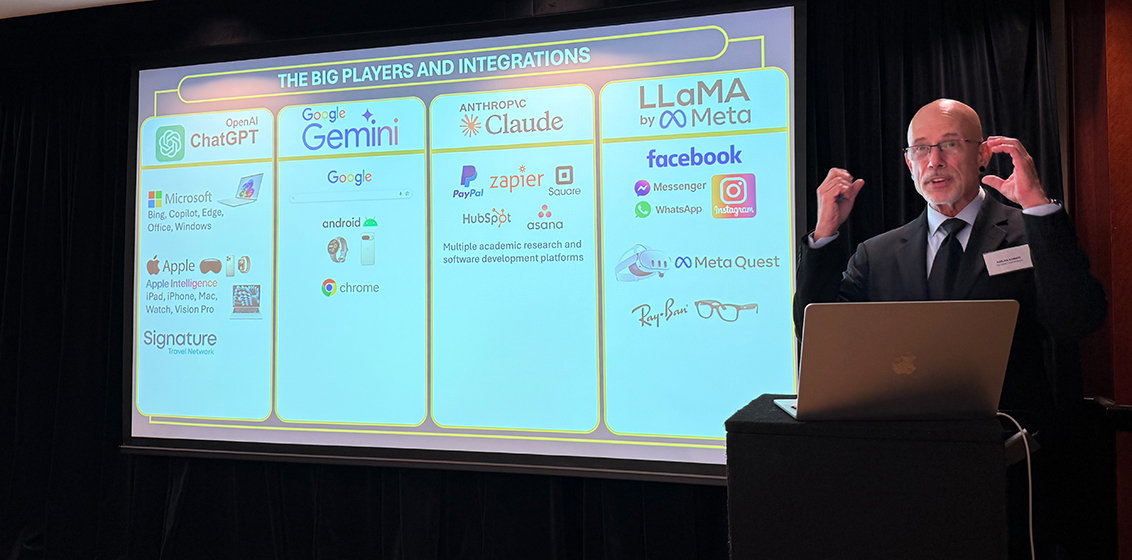
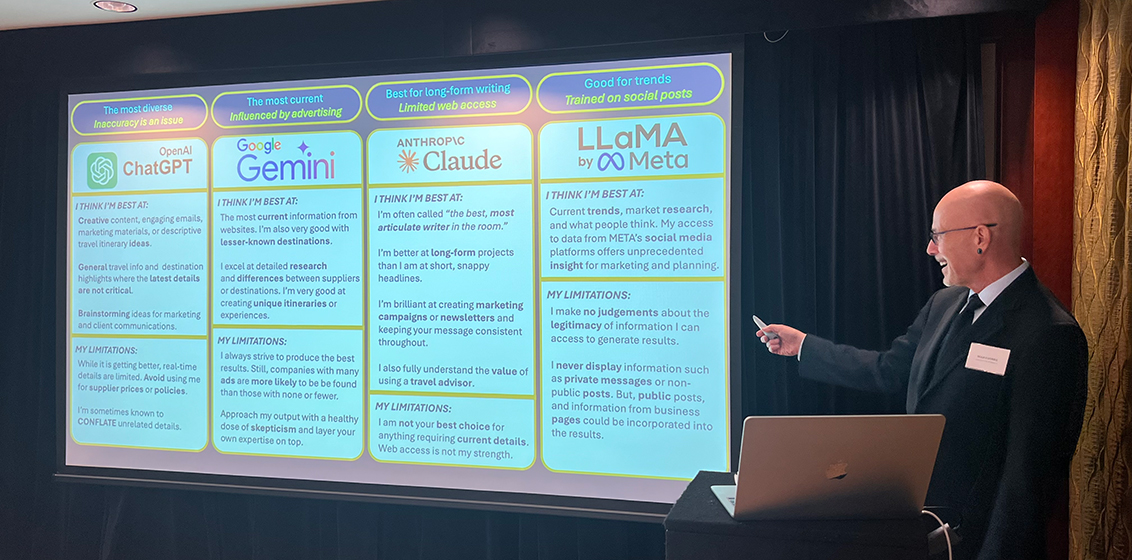
The visiting Vancouverite suggested that AI might also be “more helpful in travel marketing than anything,” discussing the four biggest players in the artificial intelligence space, namely ChatGP, Gemini, Claude and LLaMA – and how they differ.
Burris discussed three key areas where advisors can utilise AI, including basic enquiries to begin the sales process; trip planning and the ‘human’ elements, such as food and dining; and, what he believes is the most “untapped” area of AI – “using it to help you with your selling and consulting skills”.

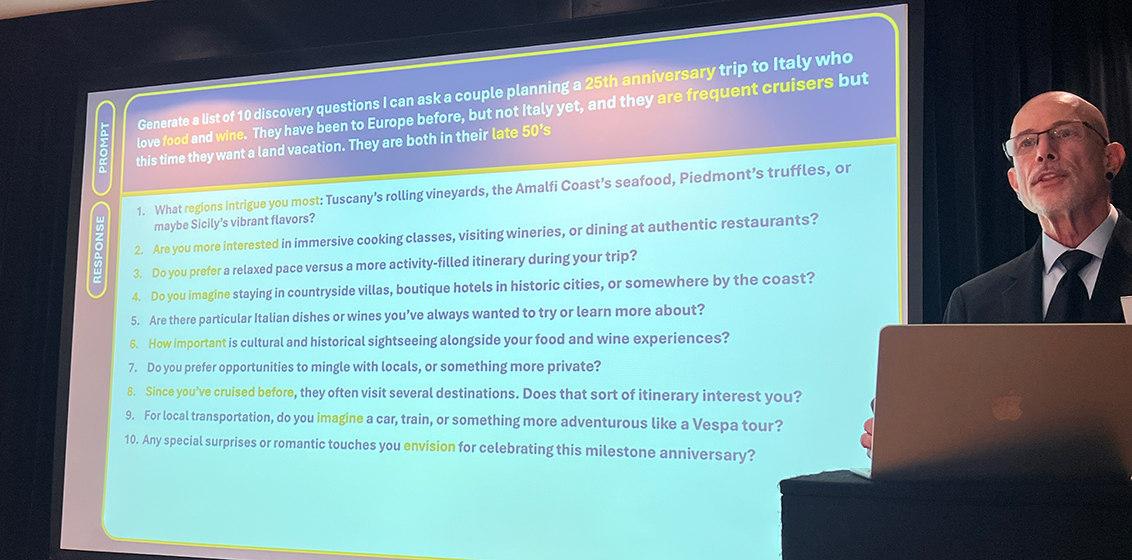
New, or even experienced travel advisors, unfamiliar with a destination a client is interested in can use AI to ask questions such as, what they should expect to be asked? and what are the top things to do in said destination?, with one AI platform going so far as offering talking points and suggested itineraries for the consultation.
He said use AI to learn about talking points such as dining options for vegetarians in the destination, and if the client has family roots to the destination, find out anything special that may link them.
“Now we’re starting to really get into the human stuff. The kind of thing that makes a trip truly personal.”
Burris said be specific with the information being sought, and to ask AI to display results in a table format that makes it easier to compare discussion points. Including a specific website URL in your search alsl enables the AI platform to use “real, known information.”
“You could just give it the website, but they don’t trawl through whole websites, yet.”
He suggests using the URLs of two different hotels to ask AI to compare their amenities, stand out features, proximity to local sites, primary clientele, etc.
AI can also be used as another set of eyes to review a proposal to a client, with Burris saying to ask the platform “Did I miss anything important?” before sending it on.
As a side note, Burris also told the Signature advisors, never to call a proposal a “quote”.
“Call it anything but a quote because you know you spent hours preparing it. They think you might have just looked at Expedia to come up with a number when you call it a quote. Call it the results of your research.”
His expert comparative analysis of the four main AI systems, in short, determined;
- OpenAI’s ChatGPT is the most diverse, however inaccuracy is an issue
- Google’s Gemini is the most current, but influenced by advertising
- Anthropc’s Claude is best for long-form writing, but has limited we access, and;
- Meta’s LLaMA is good for trends, while being trained on social posts.
But, what is it that a travel advisor can do that artificial intelligence is completely incapable of?, he questioned his Signature Travel Network audience?
“Care. Humanity.”
“When you think about how you would articulate your value. How you would sell yourself? That should be the absolute focus, because AI is going to get better and better and better… and it will get to the point when the consumer won’t know that they’re not talking to a human. It’s a little scary.”
“We must focus on our humanity, make it every single enquiry, even with repeat clients, maybe even especially with repeat clients, because they forget.
“They forget that when they spoke to you a year ago, how great you were.”
“Integrate [humanity] throughout your whole sales process with your clients, and always be mindful that even if they’re not saying it out loud, somewhere they are thinking why should I use you? So answer it before they even ask, because they’re probably not going to ask. Be proactive about it. And be eloquent about it.”
Burris used the analogy of an ultra-luxury cruise brand with its heavy and glossy brochure with strong visuals but not having a cruise expert to discuss the brand and brand.
He quipped, “If the only thing in the brochure was, Yeah, we have some great cruises and some nice food, come on, it’s only $25,000, you’ll have a great time! – then they’d be out of business tomorrow!”
“You, as travel advisors, lead the discussion with the client about the product, and you make it personal. What is service. What is being attentive.
“Share your stories of how you rescued a client during their travels. You’ve all got those stories. And make it human.”
“My smartphone. My watch, can actually book a cruise. Only another human can actually care.”